Technical Foundations & Whitepapers
Modular, inspectable, built to last. Structured documentation explaining how the framework works, what assumptions it relies upon, and where interpretive boundaries properly sit.
Reference Architecture
Eight stages from raw communication metadata to capital-relevant outputs, designed for captive insurance programs where governance behavior is the variable that drives cost. Each phase produces well-defined artifacts consumed by subsequent stages.
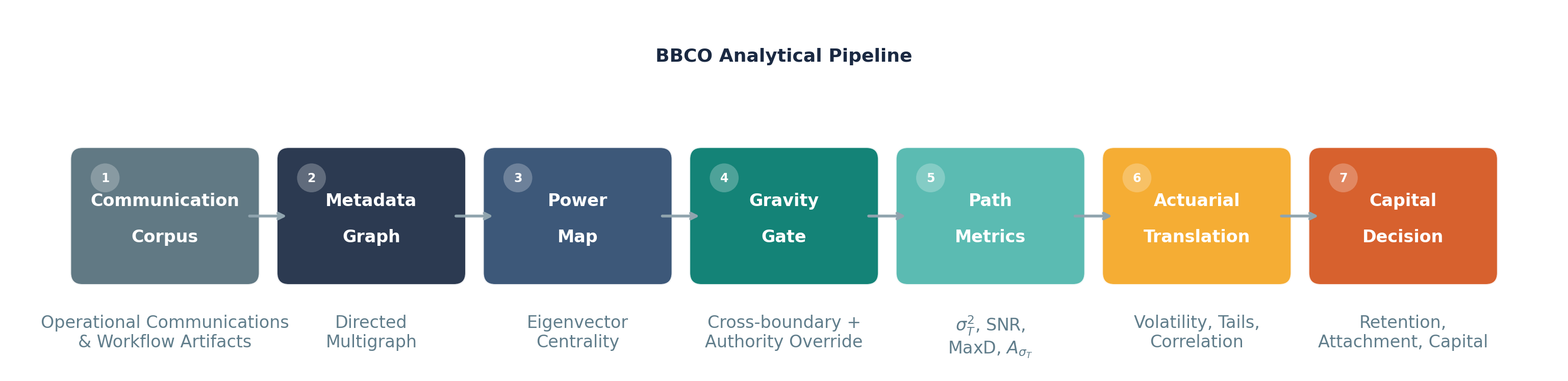
-
Phase 0, Data Quality
Entity resolution across aliases, exponential recency decay, and system-account filtering. Normalizes sender and recipient identities so downstream phases operate on consistent participant records.
-
Phase 1, Structural Substrate
Builds the directed, weighted communication graph and computes eigenvector centrality. Assigns participants to tiers: Authority (top 5%), Influence (top 15%), Standard. These tiers inform the gravity gate and behavioral scoring.
-
Phase 2, Gravity Gate
Deterministic filtration that selects messages for behavioral scoring. The gate applies structural criteria based on escalation topology and participant centrality. Messages that pass represent deliberate escalation or authority-level communication. Every gate decision carries a structured reason code.
-
Phase 3, Behavioral Signal Extraction
LLM-scored behavioral markers on eligible messages. Each message is evaluated across multiple governance-relevant dimensions and assigned a composite gravity score. Messages exceeding the gravity threshold proceed to path construction.
-
Phase 4, Path Construction
Reconstructs issue paths from individual messages using email headers and subject-line fallback. This is the aggregation boundary: analysis shifts from message-level to path-level. Each path carries a termination depth, participant set, and link-source provenance.
-
Phase 5, Termination Depth Variance (σ²T)
The flagship governance stability metric. Computes variance of termination depths per escalation shape type within rolling time windows. Low variance signals consistent governance; spiking variance signals governance disruption.
-
Phase 6, Diagnostics
Computes intensity-adjusted depth, mean pairwise graph similarity, shared node ratios, overlap coefficients, and tail probabilities. Validates upstream metrics without altering them.
-
Phase 7, Capital Logic
Translates stability metrics into capital-informing quantities using credibility weighting, upper bounds, and tail quantiles. Outputs inform attachment points, retention levels, and reinsurance structures while leaving prescriptive decisions to qualified professionals.
Design Principles
Determinism, auditability, and temporal stability across the entire pipeline.
Controlled Variability
All non-scoring stages are deterministic and configuration-bound. Identical data and parameters generate identical results. Behavioral scoring is intentionally constrained. It runs at low temperature with auditable prompts so that variability remains measurable and governed.
Auditability
Every step is transparent. Intermediate outputs are available for inspection, open to challenge rather than sealed behind an opaque inference layer.
Temporal Stability
Representations are held stable across periods so that comparisons between windows reflect underlying behavior rather than shifting definitions.
Supported Data Sources
Communications metadata from the systems organizations already use.
The pipeline normalizes disparate sources into a unified governance graph. The specific system matters less than the presence of consistent structural fields: a timestamp, a sender, one or more recipients, and a thread or encounter-linked identifier. Email alone is sufficient to begin. Additional sources deepen the graph over time.
Email Archives
PST (Outlook/Exchange), MBOX, and EML formats ingested directly with no manual reformatting. RFC 5322 headers provide the strongest native threading: Message-ID, In-Reply-To, and References reconstruct full escalation lineage. Microsoft 365 message trace and Google Workspace log exports are also supported.
Incident & Risk Management (RMIS)
Header-level and line-level incident exports from PointClickCare, RLDatix, American Data Network, MatrixCare, and equivalent platforms. Structured severity fields, assignment changes, and escalation audit trails map directly to behavioral markers in the analysis.
EHR Workflow Modules
Event and incident workflow data from electronic health record platforms. Encounter-linked identifiers, status transitions, and escalation routing from clinical governance layers. Clinical records and resident data are never ingested.
Ticketing Systems
ServiceNow, Jira, Azure DevOps, PagerDuty, and equivalent platforms. Ticket lifecycle data including assignment history, status transitions, priority changes, and linked tickets provide structured escalation metadata with built-in temporal ordering.
Chat and Messaging
Slack, Microsoft Teams, Google Chat, and equivalent platforms. Threaded conversations with channel context and participant metadata. Platform-native threading models (thread_ts, replyToId, thread.name) provide intra-system linkage.
ERP and Operational Systems
Workflow and approval chain data from enterprise resource planning and operational management platforms. Purchase order escalations, compliance review chains, and internal audit trails produce governance trace data relevant to manufacturing, logistics, and family office portfolio operations.
Whitepapers, Slides & Videos
The papers define core concepts, rationale, assumptions, limits, and interpretive boundaries.
Whitepapers
BBCO Explainer: Behavioral-Based Capital Optimization
The foundational whitepaper. Describes how everyday organizational communications are extracted, linked into issue paths, and scored for behavioral gravity, then how termination depth variance (σ²T) is computed per escalation shape type to measure governance stability over time. Covers credibility-weighted capital logic, the law of total variance decomposition, and an Enron corpus case study demonstrating composition shift analysis. Includes explicit treatment of the boundaries between structural observation and interpretive judgment.
v1.0 2026
Request WhitepaperVideos
BBCO Pipeline: Use Case Overview
A concise walkthrough of the BBCO framework, from message extraction and graph construction through behavioral scoring and capital integration. Demonstrates the end-to-end pipeline applied to a captive insurance governance scenario.
Video 2026
Watch on HomepageStandards for Formal Work
Precision, derivation, and documented limits.
Definitions
Every term, symbol, and assumption is defined precisely. Readers should never have to guess what a variable means.
Mathematical Rationale
Formal equations with explicit derivation. Every formula traces back to stated assumptions and boundary conditions.
Interpretive Limits
Explicit statements about what the work claims and where its limits lie. Limits are documented as carefully as capabilities.
This section changes slowly and only through visible community process. Proposed modifications follow the process described in Stewardship.