Shape Types Without the Math
The BBCO whitepaper defines four escalation shape types using formal notation. If you are not comfortable with that notation, this post explains the same ideas in plain language.
What Is a Shape Type?
When an issue moves through an organization, it follows a path. Someone raises it. It gets forwarded, escalated, discussed, assigned. Eventually it resolves, or it does not.
The shape of that path describes its structural complexity. How deep did the issue travel? How many people were involved? Did it cross departmental boundaries? Did it reach someone with real authority?
Shape types are a way of grouping issue paths by their structural fingerprint. They are determined entirely by graph topology, the structure of who communicated with whom, in what sequence, not by what was said.
How Boundaries Are Detected
Shape classification depends on knowing when a message path crosses an organizational boundary. BBCO detects these boundaries using Louvain community detection on the undirected communication graph. The algorithm identifies clusters of people who communicate more densely with each other than with outsiders. When a thread’s participants span multiple clusters, the path is said to cross a domain boundary.
These communities are not actual org chart departments. They are communication clusters, groups of people who email each other more densely than they email outsiders. The assumption is that communication clusters correlate with organizational units (teams, departments, business lines). That is usually a reasonable proxy, but it is inferred from communication patterns, not from ground truth organizational data.
Similarly, authority nodes are not identified by job title. They are the top 5% of participants by eigenvector centrality in the communication graph (or top 1–2% in larger enterprises), the people who sit at structural hubs of information flow. The threshold scales with organizational size: 5% for organizations under 1,000 employees, 2% for 1,000–10,000, and 1% for those above 10,000. The pipeline infers organizational importance from communication topology, not from metadata about roles.
This design choice is what makes BBCO applicable to the small and mid-size captives where governance observability matters most. Because the pipeline discovers boundaries from communication topology rather than requiring an org chart, a role taxonomy, or any sector-specific metadata, the same classification logic works whether the captive is a regional manufacturer managing product liability and recall, a professional services firm underwriting E&O, or a technology company three years into a D&O program. These are the on-ramp organizations: captives in their first three to ten years, building a governance track record but lacking the loss history to demonstrate it actuarially. Any organization that produces communication data produces the structure these methods operate on.
For these smaller captive programs, the communication graphs tend to be sparser than those of large enterprises. Fewer participants, fewer cross-boundary threads, tighter clusters. This is where the choice of community detection algorithm matters. The original pipeline uses Louvain community detection, which is well-established and widely available. However, Louvain has a known structural flaw: it can produce communities that are internally disconnected, assigning participants to the same cluster even when they share no communication path through other members of that cluster. In dense graphs with thousands of participants, this rarely causes problems. In the leaner graphs typical of a 200-person captive parent, it can merge distinct communication groups and cause the pipeline to undercount boundary crossings, which directly affects Shape 3 and Shape 4 classification.
While the whitepaper specifies Louvain clustering, the production BBCO pipeline has since adopted the Leiden algorithm (Traag, Waltman & van Eck, 2019), which addresses this flaw by guaranteeing that every detected community is internally connected. After each optimization pass, Leiden verifies connectivity within each cluster and splits any that fail. For the captive-scale graphs BBCO targets, this produces more faithful communication boundaries and more accurate shape classification, because a cluster that is internally disconnected merges people who share no communication path through fellow members. When Leiden splits that cluster, two groups that never actually communicated through each other become two distinct communities, and a thread that spans both now correctly registers as a boundary crossing rather than being invisible inside a single oversized cluster. Leiden is a drop-in replacement: same input (the undirected communication graph), same output type (community assignments), same downstream logic. The difference is that the clusters it produces better reflect the actual communication topology, which is precisely what shape classification depends on.
With these definitions in place, clusters as proxy for departments, centrality as proxy for authority, the four shape types describe distinct structural patterns.
How Depth Is Computed
The term depth appears throughout the shape type definitions. It has a specific, concrete meaning: depth is the number of messages in the thread. The pipeline groups messages by normalized subject line, sorts them by timestamp, and counts them. A thread with three emails has depth 3.
Depth does not count levels in a hierarchy or measure hops between people and it does not require knowledge of reporting relationships. It is simply: how many messages accumulated in this issue path before it stopped.
This matters because depth is the primary input to shape classification. Combined with cluster span, fan-out, and authority involvement, it determines which shape type a path receives:
| Shape | Depth | Clusters | Authority | Fan-out |
|---|---|---|---|---|
| 1 Lateral | = 1 | any | any | any |
| 2 Escalation | ≥ 2 | 1 or 2 | any | any |
| 3 Spread | ≥ 3 | ≥ 2 | any | > depth |
| 4 Cascade | ≥ 4 | ≥ 3 | top 5% | any |
The classification is evaluated top-down: a thread that meets Shape 4 criteria is classified as Shape 4 even if it also meets Shape 3 criteria. Shape 2 is the catch-all for any multi-message thread that does not meet the structural requirements of Shape 3 or 4. Shape 1 captures single-message paths, the pipeline registered the message as high-gravity, but no reply thread formed.
The Four Types
Shape 1: Routine Lateral
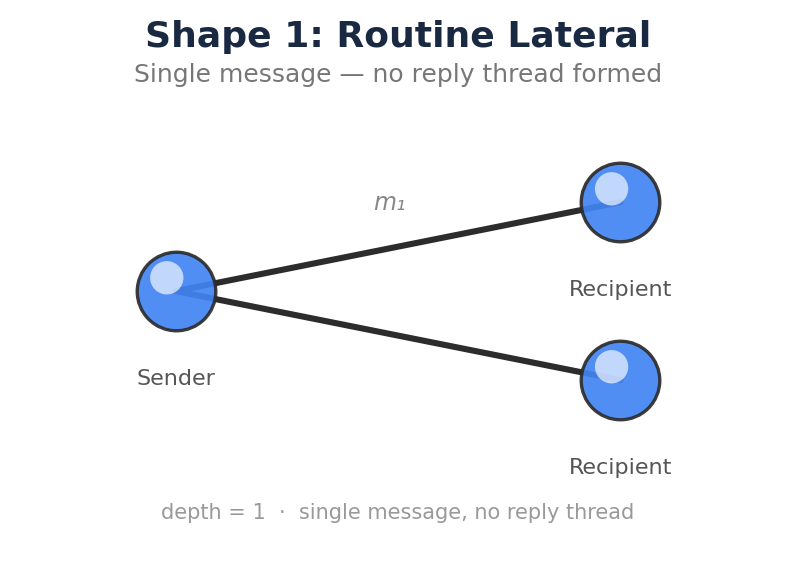
A single message that passed the gravity gate but generated no reply thread. Depth = 1. An earlier pipeline segment using an LLM registered the message as behaviorally significant (high gravity), but the issue resolved (or was ignored) without further exchange.
Shape 1 paths dominate most organizations by volume. In the Enron corpus, they accounted for roughly 88% of all high-gravity paths, though this figure is inflated by a known sample limitation: the corpus covers only 150 of Enron’s roughly 20,000 employees (0.75%), and its email files contain no threading headers (In-Reply-To / References), so replies whose parent message falls outside the sample appear as orphan depth-1 paths. In a full-boundary corpus, the true Shape 1 share would likely be lower. Regardless of the specific percentage, Shape 1 matters not for its signal content but for its composition share—when the proportion of single-message paths shifts, it changes what the aggregate statistics reflect.
Shape 2: Vertical Escalation
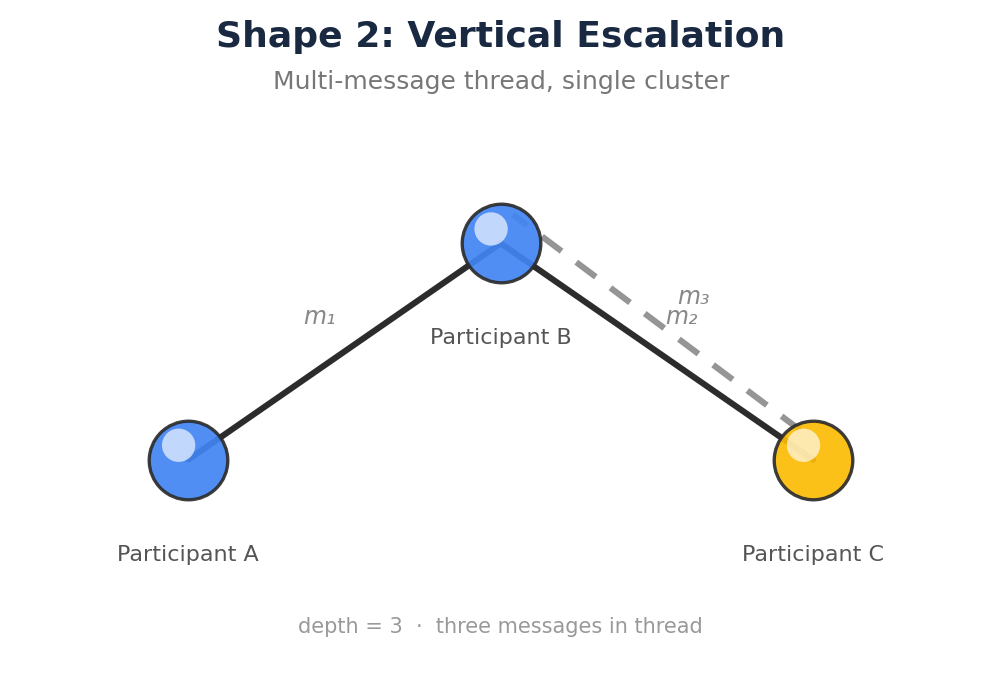
A multi-message thread (depth ≥ 2) whose participants stay within one or two communication clusters. The thread generated replies, forwards, or follow-ups, but did not spread across cluster boundaries or involve enough structural complexity to qualify as Shape 3 or 4.
The name “Vertical Escalation” reflects the typical interpretation: a thread that stays within one cluster and grows deeper usually represents internal escalation within a team or reporting chain. But the pipeline does not verify this, it infers escalation from message count and cluster containment, not from hierarchy data.
Shape 2 paths carry real but narrow variance. When these paths start terminating at inconsistent depths, some at two messages, others at eight, the variance rises, suggesting that the organization’s internal escalation norms are becoming less predictable.
Shape 3: Multi-Domain Spread
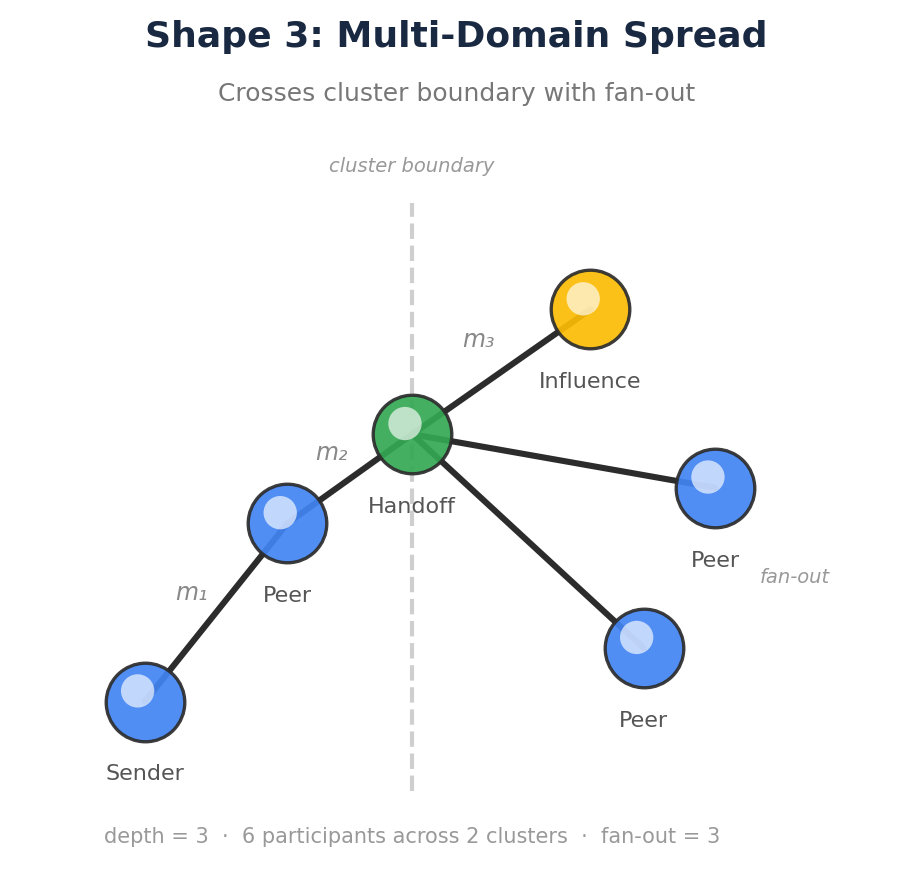
A thread with depth ≥ 3 whose participants span at least two detected clusters, with fan-out (more participants than messages in the thread). The issue generated enough exchange to cross a communication boundary and involve people outside the originating cluster. This is where the accuracy of cluster detection matters most: if the algorithm merges two genuinely separate groups into one cluster, boundary crossings go undetected and Shape 3 paths get misclassified as Shape 2.
This is where governance behavior starts to become visible. The path reveals not just that the issue was escalated, but how it was routed across the seams between communication clusters. When Shape 3 paths show increasing depth variance over time, it suggests that the organization’s cross-cluster escalation discipline is becoming inconsistent.
Shape 4: Executive Cascade
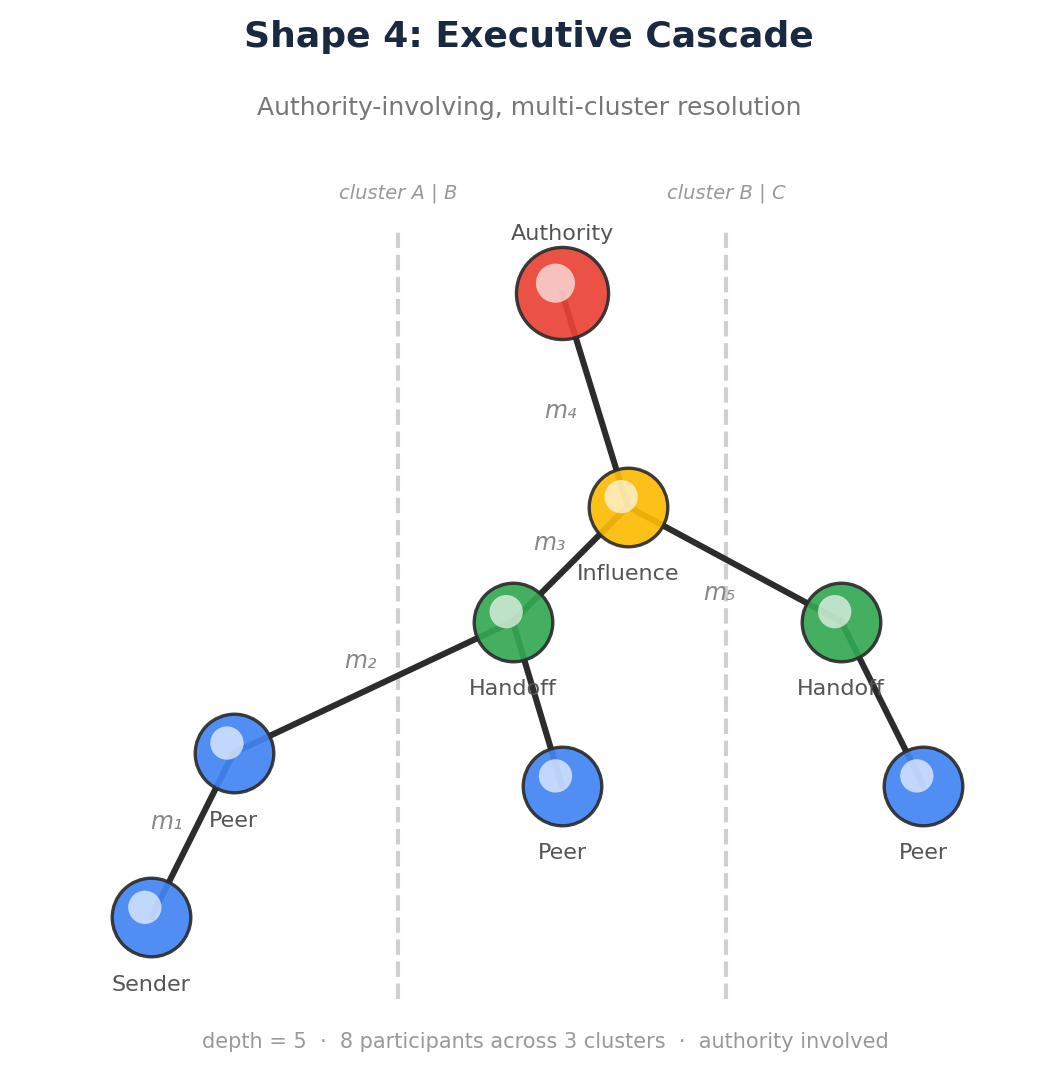
A thread with depth ≥ 4 whose participants span at least three detected clusters and include an authority node (a top-5% PageRank participant, someone who sits at a structural hub of communication flow). These paths represent issues that generated enough exchange to cross multiple communication boundaries and pull in someone with structural importance. The three-cluster threshold makes Shape 4 particularly sensitive to cluster quality: Leiden’s guarantee of internal connectivity prevents the false merges that would cause the pipeline to undercount boundary crossings at this level.
Shape 4 paths are the primary signal carriers. When they behave consistently, similar depths, similar routing patterns, it suggests that the organization’s governance structure is functioning predictably. When they do not behave consistently, something has changed. Because Shape 4 occurs infrequently, credibility weighting is applied to prevent small samples from producing misleading estimates.
Why Shape Types Matter: Composition Shift
Without shape types, you would measure variance across all issue paths together. The aggregate number can move for two entirely different reasons: either individual shape types become less stable, or the mix of shape types changes.
On the Enron sample, aggregate termination depth variance rose 54% during the stress period. No individual shape type became substantially less stable internally. What changed was the composition: Shape 1’s share of high-gravity paths dropped from 88% to 70%, and the displaced share redistributed to deeper shapes. These are pipeline outputs on a 0.75% custodian sample with absent threading headers—they illustrate the composition shift mechanism, but whether they reflect genuine governance deterioration at Enron or artifacts of the sample boundary cannot be determined from this corpus alone. Validation on a full-boundary corpus (where the organization is the corpus boundary) is required before drawing governance conclusions.
This is the composition shift mechanism. It is formalized through the law of total variance, which decomposes overall variance into a within-shape component (how variable each shape type is internally) and a between-shape component (how different the shape types are from each other). In the Enron sample, 97% of the variance sits between shapes and only 3% within. Shape-type stratification makes this distinction visible and prevents composition changes from masquerading as governance instability.
The Practical Consequence
If you are a risk professional looking at BBCO outputs, the shape type column tells you what kind of governance challenge each metric describes. High variance in Shape 4 means something different from high variance in Shape 2.
If you are an engineer building on the BBCO pipeline, shape type classification is a pure graph operation. It uses community detection (Louvain for larger corpora, Leiden where guaranteed cluster connectivity matters) for cluster boundaries and PageRank centrality for authority identification. It requires no content analysis, no embeddings, no language models. It is deterministic, auditable, and stable.
Shape types separate the routine from the consequential, so that signals about governance behavior are not drowned out by operational noise.
Read more from the BBCO community.